Travel Bag
There is a moment that happens about three hours into a long travel day. It doesn’t matter if you are navigating the metro in Paris or shuffling through security at O’Hare. Your shoulders start to ache. The handle of your suitcase feels slick with sweat. That “perfectly good” bag you grabbed from the back of your closet suddenly feels like a punishment.
Most people buy a travel bag based on looks or price. They end up with a sore back, broken zippers, or the dreaded “I have to check this because it doesn’t fit” disappointment at the gate. The right travel bag doesn’t just hold your socks and toothbrush. It acts as a silent partner in your journey. It lets you move faster, stay organized, and arrive less frazzled. But to find it, you have to stop looking at bags and start looking at yourself.
The Three Questions You Must Ask Before Looking at Bags
Before you open a new tab and start scrolling, sit down and answer these three questions honestly. They will filter out 80% of the bad options immediately.
What is your travel style?
Are you a planner who books hotels months in advance, or a drifter who decides where to sleep while eating breakfast? If you are dragging a bag across fields at a music festival or hopping on and off tuk-tuks, your needs differ drastically from someone rolling a bag from a taxi into a five-star lobby.
How long is your trip?
There is a massive difference between a long weekend and a three-week trek. However, a common mistake is assuming a longer trip requires a bigger bag. It doesn’t. It requires a different bag and a willingness to do laundry.
How do you move?
Be honest about your physicality. Will you be carrying this thing up four flights of walk-up apartment stairs in New York? Will you be sprinting through train stations in Italy? Or will it only ever travel on smooth airport floors and in the trunk of a car? Your body will thank you for answering this truthfully.
The Great Debate: Backpack vs. Wheeled Luggage
This is the fork in the road. You generally have to pick a side, because hybrid options often compromise both functions.
When a Travel Backpack Wins (Freedom & Rough Terrain)
If your trip involves stairs, grass, gravel, sand, or snow, wheels become dead weight. A backpack distributes the load across your shoulders and hips, leaving your hands free to hold a map, a coffee, or a railing. It makes you more agile. In crowded spaces, you move with the crowd rather than trailing a hard case behind you that knocks into ankles.
When a Wheeled Suitcase Wins (Comfort & Organization)
If you are traveling for business, covering long distances in large airports, or simply have a bad back, wheels are a modern miracle. A good spinner suitcase glides beside you with minimal effort. They are generally more structured, meaning your clothes stay pressed and your electronics are easier to access.
The Hybrid Contender: The Rolling Backpack
These look like a backpack with wheels and a collapsible handle. In theory, they offer the best of both worlds. In practice, they are usually mediocre at both. They are uncomfortable to wear for long periods because the backpack straps are often thin and unpadded to allow them to tuck away, and they are unstable to roll because they are tall and narrow.
Breaking Down the Main Types of Travel Bags
Once you know whether you are carrying or rolling, you can narrow down the specific shape.
The Carry-On Suitcase (Hardside vs. Softside)
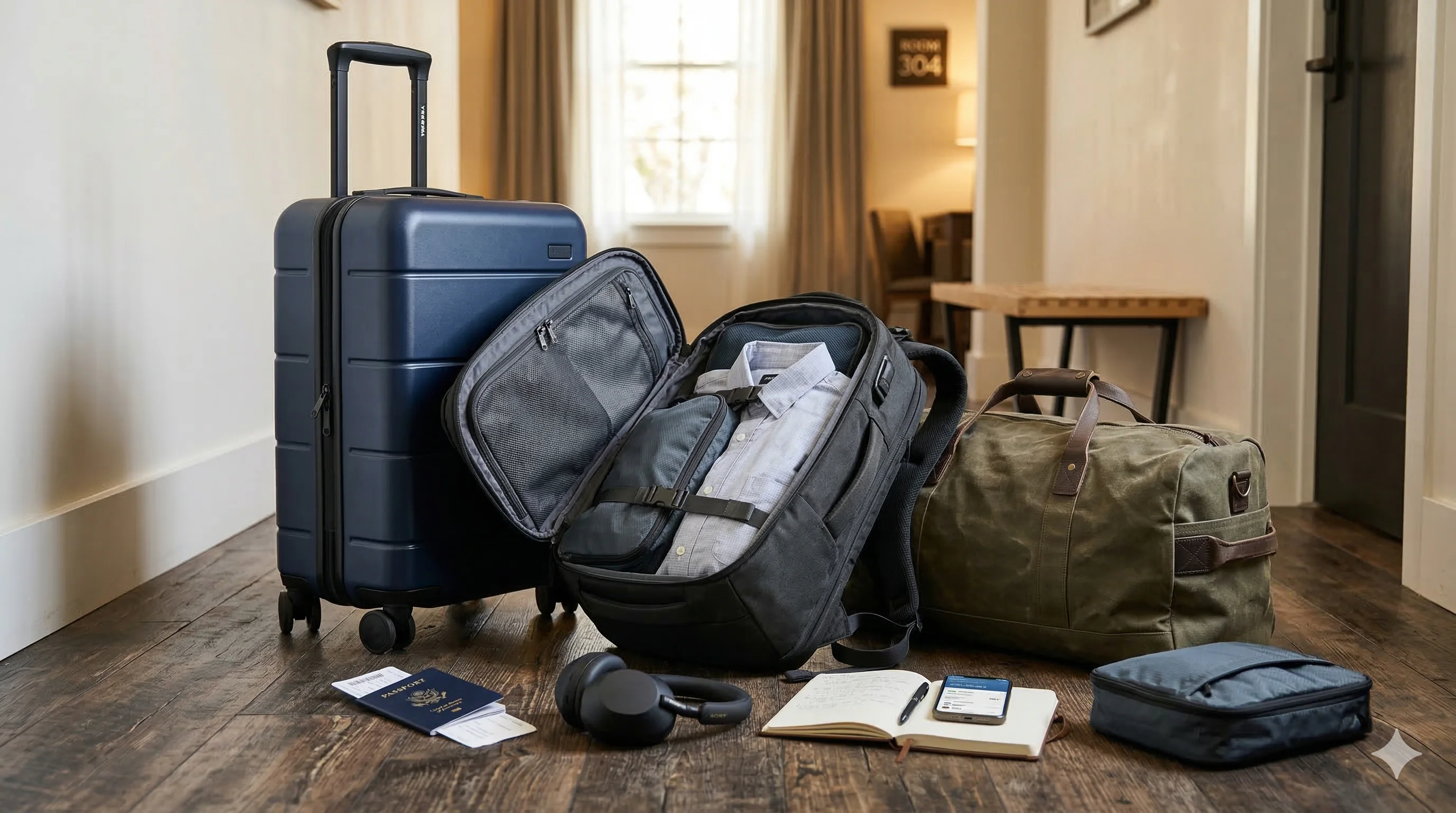
This is the king of modern travel. It forces you to pack light.
- Hardside (Polycarbonate or ABS plastic): Excellent for protecting fragile items. They don’t stain and often look new for years. However, they have no external pockets, so you have to open the whole thing to get your book out, and they don’t expand.
- Softside (Ballistic nylon or canvas): These usually have front pockets for quick access to laptops or documents. They are lighter and often have expansion zippers for souvenirs. The trade-off is that they are less waterproof and can tear if snagged.
The Duffel Bag (The Minimalist’s Choice)
Duffels are essentially fabric sacks. They can be squished into overhead bins or crammed into small spaces. They are perfect for road trips and adventure travel where weight is the enemy. The downside? Organization. Without packing cubes, a duffel becomes a dark hole where socks go to get lost.
The 40-50 Liter Backpack (The One-Bag Traveler’s Best Friend)
This is the sweet spot for serious travelers. It is small enough to carry onto a plane (usually) but large enough to hold gear for an indefinite trip. These bags prioritize comfort, with proper suspension systems, hip belts that take the weight off your shoulders, and compression straps to keep the load tight against your back.
The Weekender Bag
Often made of canvas or leather, this is a style-first option. It is designed for a short car trip or as a gym bag. While it looks great, it usually lacks the ergonomic support or security features needed for serious international travel.
Materials and Durability: What to Look For
You want a bag that survives baggage handlers and monsoon rains without falling apart.
Fabrics: Denier, Nylon, and Polyester Explained
You will see numbers like “600D Polyester” or “1000D Nylon.” The “D” stands for Denier, which is the thickness of the fibers. Generally, higher numbers mean more durability but also more weight.
- Ballistic Nylon: Originally designed for flak jackets. It is incredibly abrasion-resistant and the gold standard for high-end softside luggage.
- Cordura: A brand name for a type of high-tenacity nylon that is also extremely tough.
- Polyester: Usually cheaper and lighter, but can degrade in sunlight and is less abrasion-resistant than nylon.
Zippers Are the Weakest Link
A bag can be made of indestructible fabric, but if the zipper breaks, the bag is dead. Look for bags that use YKK zippers. They are the industry standard for a reason. Also, look for zippers with large, easy-to-grab pulls and ask yourself if the zipper track has a weather-resistant coating.
Handle and Strap Construction
Check the stitching where the handle meets the bag. Is it reinforced with bar-tacking (dense zig-zag stitches)? Are the backpack straps anchored to the bag with webbing that wraps around the entire panel, or just sewn on the surface? The way a handle is attached tells you how long the bag will last.
Must-Have Features for the Modern Traveler
Beyond the basic shape, look for these modern upgrades.
Security Features
- Lockable Zippers: Can you slip a small TSA-approved lock through the zipper pulls?
- Slash-Resistant Materials: Some bags now incorporate steel wire mesh into the fabric to prevent slash-and-grab theft.
- RFID Blocking: Useful if you carry a passport or credit cards with chips, though the necessity of this is often debated.
Accessibility
- Clamshell Opening: This is when the bag opens like a suitcase, with two halves. It makes packing and unpacking infinitely easier than a top-loading bag where everything piles on top of each other.
- Laptop Sleeves: Ideally, the laptop sleeve should be on the outside of the main compartment so you can slide your computer out at security without opening the entire bag.
Weight Distribution (For Backpacks)
If you are carrying weight on your back for more than 20 minutes, you need a proper harness.
- Hip Belt: This should be padded and wrap around your hip bones. It transfers the weight from your shoulders to your legs.
- Load Lifters: These are small straps on the top of the shoulder straps that pull the pack closer to your body. If your bag doesn’t have these, it’s not designed for serious carrying.
How to Match Your Bag to Your Destination
Let’s apply the theory to real-world trips.
The European City Break
You need a bag that can handle uneven pavement and crowded metros. A small, wheeled spinner (20-22 inches) with four multi-directional wheels works well, provided you can lift it onto trains. Alternatively, a sleek 30L travel backpack keeps you nimble. Focus on anti-theft features like locking zippers.
The Southeast Asia Backpacking Trip
Wheels are a liability here. You need a durable backpack (40-50L) with a rain cover or water-resistant fabric. You will be on boats, in the back of trucks, and walking on beaches. A top-loading design or a panel-loader with compression straps will serve you well.
The Business Trip
Go with a wheeled carry-on (hardside or softside) paired with a separate briefcase or “personal item” backpack. Look for a suitcase with a “garment folder” or suit pocket to keep blazers wrinkle-free. The wheels should be quiet and smooth.
The One-Bag Travel Philosophy
There is a growing movement of travelers who refuse to check bags. They take one bag—usually a carry-on backpack or small spinner—everywhere.
Why Limiting Space Limits Stress
When you only have the space on your back or under the seat in front of you, you stop bringing “just in case” items. You pack for the trip you are actually taking, not the fantasy trip where you need three pairs of shoes. You move faster, you never wait at baggage claim, and you never lose your luggage.
Packing Cubes: The Perfect Accessory
No matter what travel bag you choose, packing cubes will change your life. They act as drawers inside your bag. You can compartmentalize: one cube for shirts, one for pants, one for underwear. When you arrive at your destination, you simply lift the cubes out and put them in the hotel drawers, or live out of them directly. They compress your clothes, saving space and reducing wrinkles.
Conclusion: The Best Bag is the One You Forget You’re Carrying
Stop looking for a bag that looks good in a magazine. Start looking for a tool that works for your body and your plans. The perfect travel bag is the one that lets you step off a train, look around at a new city, and feel excited rather than exhausted. It is the one that holds up after years of use, becoming worn in all the right places.
Invest your time in the choice, not just your money. Because the right bag doesn’t just carry your luggage; it carries your freedom.
FAQs:
- What is the best size for a carry-on travel bag?
Most airlines restrict carry-on luggage to 22 inches tall, 14 inches wide, and 9 inches deep (including wheels and handles). Always check your specific airline’s policy, as budget carriers often have stricter limits. - Is a hardside or softside suitcase better?
Hardside offers better protection for fragile items and is weather-resistant, while softside is usually lighter, offers external pockets for easy access, and can expand to fit extra souvenirs. - Can I use a hiking backpack as a travel bag?
Yes, but hiking backpacks are tall and deep. They may not fit carry-on sizers. Travel-specific backpacks are designed to be shorter and wider to comply with airline regulations while still holding a lot of gear. - How do I clean my travel bag?
For softside bags, spot clean with mild soap and a damp cloth. For hardside, a wipe down with disinfectant wipes works well. Never machine wash a suitcase or technical travel backpack, as it can ruin the frame and coatings. - What is the difference between a duffel bag and a travel backpack?
A travel backpack has a suspension system (padded back, hip belt, sternum strap) to distribute weight ergonomically. A duffel bag is essentially a sack with handles; it is not designed to be carried for long distances on your back.
About the Author